


Modular hoarding for public spaces: faster, safer fit-out and refurbishment
Refurbishment and fit-out work often happens while buildings continue to operate. Passengers continue their journeys while airport terminals are upgraded around them. Patients carry on receiving care and treatment while hospitals are refurbished. Inmates stay exactly where they are while prison wings are worked on. And the show must go on while stadiums are rebuilt or upgraded. In each of these environments, the construction team must ensure building work is carried out safely, cleanly, and quickly, without impacting the building's purpose or the people inside.
In these huge refurbishment and fit-out projects, there’s a lot to coordinate, from workers and suppliers to the logistics required to keep these busy public spaces operational. Amongst it all is an unsung hero - the hoarding that divides the work area from the public. Done right, the work area can be screened off and kept out of sight, keeping the public safe and the spaces quiet and dust-free. Done wrong, and critical public infrastructure can become impacted by noise, safety incidents, infection control breaches, or worse.
Challenges when upgrading public spaces
Regardless of the sector, every public building undergoing construction faces the same challenge: balancing public safety with operational continuity.
In hospitals, the priority is infection control and patient wellbeing. For work to proceed, hoarding must maintain strict hygiene standards, prevent contamination in clinical areas, and keep inpatients, staff and visitors moving safely around the building. Safety regulations also require the hoarding to meet fire safety requirements and be strong enough to withstand crowd loading in busier corridors. Installation windows are often short, and the workforce must follow clinical hygiene protocols while on site.
In education settings, the pressure usually stems from running a project around an occupied campus. Teaching spaces must remain usable, which means keeping them free from noise and dust. Projects are usually phased, requiring hoarding that can be moved around the building as work progresses. Student and staff safety is also critical.
In stadiums and arenas, crowd loading is a real issue. Hoarding must be engineered to withstand the physical presence of thousands of fans, meet fire safety design standards, and often needs to blend in to maintain the customer experience.
In offices undergoing fit-out or refurbishment, the main concern is often sound reduction. Meeting rooms or work areas need to be shielded from construction noise, so business can carry on as usual, with minimal disruption to people trying to work.
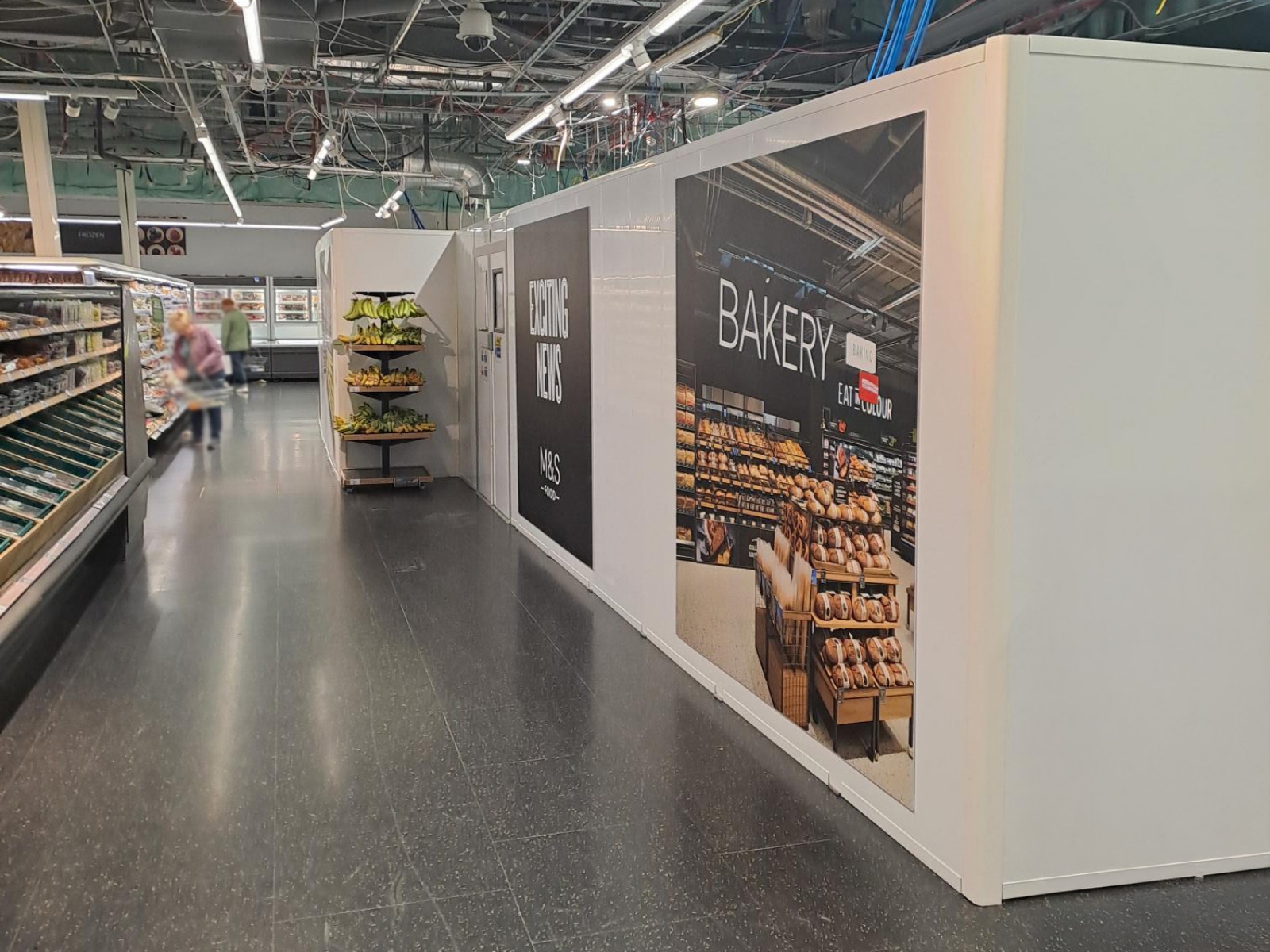
In retail, hoarding needs to protect customers and stock, which also appearing clean and professional so that it doesn't undermine the brand. Sometimes, the hoarding needs to be wrapped in marketing graphics and signage, turning a construction barrier into a customer communication tool.
In more specialised, higher-security environments, the stakes are higher. In airports, hoarding must manage passenger flow and protection, cope with crowd and wind loadings, meet strict noise and dust controls, and maintain segregation between airside and landside areas to meet Aviation Security (ASIAD) requirements. In prisons and other secure facilities, crowd loadings, fire safety, inmate segregation, decant strategy as wings are taken in and out of use, prevention of contraband being stashed inside the hoarding itself, secure "line of sight" construction zones, protection against contractor tools being dropped into inmate areas (and vice versa), and Counter Terrorism Clearance (CTC) for every worker on site.
What should a hoarding system achieve?
A genuinely fit-for-purpose temporary hoarding system needs to tick a list of boxes, including:
- Carry a certified fire rating without adding to the building's fire load, in line with standards such as BS 9999 and BS EN 13501.
- Go up quickly and cleanly, with minimal mess, and come down again with minimal disruption.
- Be designed and engineered to be reused, relocated and reconfigured easily.
- Take up as little floor space as possible.
- Provide a smooth, easy-to-wipe-clean surface with concealed joints.
- Be robust enough to be trusted in busy environments, including in crowds and winds, engineered to the structural requirements set out in BS EN 1990 and BS 5975 for temporary works.
- Be weatherproof enough to sit outdoors if needed.
- Be resistant to being breached in a secure facility, and compliant with ASIAD requirements in an airport context.
All of this sits under the CDM 2015 Regulations, which require site safety, including worker protection and environmental pollution control, to be planned from day one, not added retrospectively.
The old guard: jumbo stud and board, timber, and scaffold sheeting
For decades, the default toolkit for temporary segregation has been three familiar options. Looking at the list of what a hoarding solution should achieve, these older solutions struggle to meet the brief;
Jumbo stud and board is relatively cheap and fire-resistant, and because it's essentially a permanent partition wall, you can fix things to it and add soundproofing reasonably easily. However, it needs scaffolding to erect, which makes it disruptive, slow, and dusty to install. It also takes up more space, and, once it's up, it's not relocatable. Damage is hard to repair, security is limited, and it does very little to help meet ASIAD-style requirements.
Timber and plywood solutions use readily available materials, have short lead times, and can be adapted for soundproofing. The downsides include splinter injury risk, poor acoustic performance, and increased fire risk due to combustible materials. The heavy panels are awkward to handle, need to be painted or primed and are slow to install.
Scaffold and sheet solutions are fast and cheap to deploy, which explains why they're still common. In a live public environment, they're disruptive and space-hungry to install, almost impossible to seal dust-tight, do nothing for noise, and are easy to tear or penetrate. Critically, they carry no crowd or wind loading capacity and offer no real worker security or protection.
Modular hoarding: a more robust solution
Given the shortcomings of these more traditional solutions, the shift toward modular panel systems is unsurprising. These more innovative solutions meet fire safety, structural and health and safety legislation, helping to maintain project momentum while reducing risk.

Modular PVC panels are inherently flame retardant, with a smooth, clean finish that graphics can be applied to easily, allowing the hoarding itself to carry branding or signage. They install quickly without highly qualified installers, and because the system is genuinely modular, it's reusable and relocatable, and can be reconfigured as the project evolves. At end of life, the panels are fully recyclable.
Modular composite steel panels install three to five times faster than traditional build methods. They're fully recyclable, fire-rated, and sound-absorbing, with a smooth, clean finish that suits clinical and customer-facing environments. They have no visible joins and are stash-proof, making them the right choice for prisons and secure facilities. In many situations, they can meet ASIAD requirements outright, can be cut easily to accommodate services and penetrations, and can be used externally. Like their PVC counterparts, they can be reconfigured to suit project needs, with minimal waste.
Both systems also offer sustainability benefits:
- PVC panels are manufactured from 85% recycled material, can be hired to cut overall costs and waste, and are reusable across multiple projects.
- Composite steel panels use steel-faced construction with rockwool infill, enhancing thermal performance and reducing heating and cooling. They are often manufactured using LEAF technology, making them less energy-intensive to produce.
- Both approaches remove the need for timber paneling altogether, and because they're prefabricated, on-site installation time drops significantly compared with a build-in-place timber or stud wall.
Modular hoarding vs traditional systems: a quick comparison guide
| Jumbo Stud & Board | Timber / Plywood | Scaffold & Sheet | Modular Hoarding: Hoardfast PVC | Modular Composite Steel Hoarding: Hoardfast Firescreen | |
|---|---|---|---|---|---|
| Install speed | Slow — needs scaffolding to erect | Slow — lengthy labour times | Fast to deploy | Very quick | 3–5x faster than traditional methods |
| Disruption in occupied areas | High — disruptive to erect | Moderate — dusty, heavy panels | High — disruptive, space-hungry | Low — doesn't need highly qualified installers | Low |
| Relocatable / reconfigurable | No — not relocatable | Difficult to relocate | No | Yes | Yes |
| Fire performance | Fire resistant | Flammable | No fire performance benefit | Inherently flame retardant: BS 476 Part 7 Class 1 (Spread of Flame) and EN 13501-1 C-s3-d0 (35mm only) | Available in 30-minute (EI30) and 60-minute (EI60) fire ratings, certified to EN 13501-1 A2-s1-d0 |
| Security / stash-proof | Limited security | Joints not stash-proof | No worker security or protection | Hollow fluted panels could hide contraband | Stash-proof, no visible join; cannot be breached without tools |
| Acoustic performance | Relatively easy to add soundproofing | Poor acoustics | Does not reduce noise | Sound reducing up to 27dB | Firescreen up to 30dB Soundscreen up to 34dB |
| Services & penetrations | Can cut around services, but difficult to build around them | Can cut around services and penetrations | Easy to accommodate services and penetrations | Easy to accommodate services and penetrations | |
| Damage & repair | Easily damaged, not easily repaired | Easily damaged, not easily repaired | Easily penetrated / torn | Strong panels with excellent impact resistance | Cannot be breached without tools |
| Waste & recyclability | Not stated | High volumes of waste, not easily recycled | Not stated | Fully recyclable | Fully recyclable |
| ASIAD compliance (airports) | Very limited use in meeting ASIAD requirements | No | No | No | Can meet ASIAD requirements, subject to situation |
Theory meets practice: modular hoarding case studies
Modular hoarding in airports
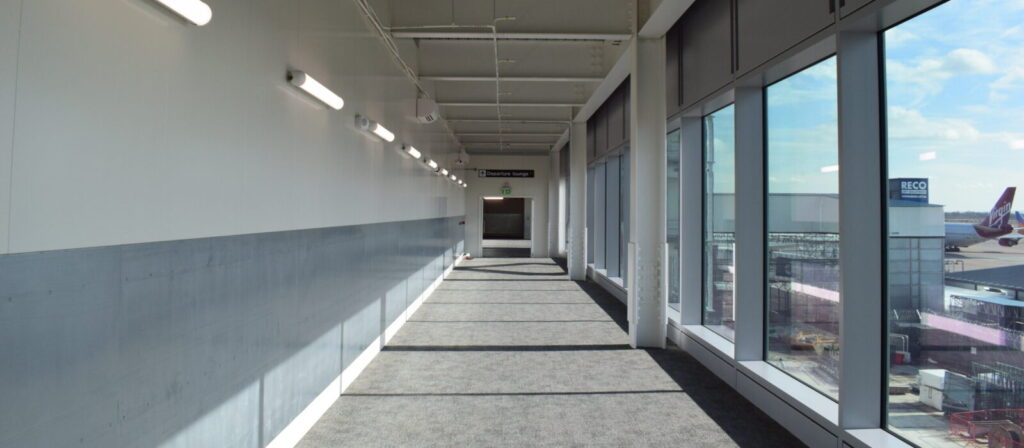
At Manchester Airport, a 400-metre temporary critical path corridor was needed during the expansion of Terminal 2. The team specified and installed a 60-minute fire-rated, steel-faced composite hoarding panel that was engineered to be both crowd-loaded and fire-rated for a corridor thousands of passengers would pass through daily. Elsewhere in the same terminal, freestanding soundscreen panels enclosed multiple retail fit-out projects simultaneously, shielding passengers from live construction works.

At Birmingham Airport, Tilbury Douglas used Hoardfast Firescreen to segregate a construction compound from public areas while preserving the passenger experience, while Vinci Construction combined a Hoardfast Firescreen external tunnel with Hoardfast Soundscreen panels to segregate a passenger walking route from works. Coupe Decor, also at Birmingham Airport, went a step further and turned their hoarding into a communication tool, wrapping it in graphics and customer messaging about the improvements underway behind it.
Modular hoarding in prisons
In two secure prison environments, Westgate Global was tasked with enclosing renovation works, maintaining full workforce security, and preserving protocols for inmates. Both projects used 60-minute fire-rated, steel-faced composite panels fixed floor to ceiling, with an engineered fabric dust screen deployed specifically to stop tools from being dropped between the works area and inmate spaces in either direction.
Modular hoarding in healthcare and education
In healthcare, RG Carter's refurbishment at the Queen Elizabeth Hospital in Norfolk needed panels that were clinical and wipe-clean, strictly dust-controlled, and 60-minute fire rated, delivered with a floor-to-ceiling Hoardfast Firescreen.
In education, Neilcott Construction's multi-phase renovation at Kingston University in London relied on a combination of Hoardfast Firescreen and Soundscreen to keep fire safety, noise and dust under control as work moved through the occupied campus in stages.

Modular hoarding in offices and retail
In the office sector, Signature's London fit-out used Hoardfast Soundscreen to create genuinely private meeting rooms inside a live working environment, while Wates' work at One Sherwood in Piccadilly needed 60-minute fire-rated hoarding that also handled site welfare and weatherproofing duties — solved with the same Firescreen system.

In retail, Caddick Construction built a three-sided Hoardfast Firescreen tunnel to keep shoppers moving safely past works on the other side of a shopping centre walkway. M&S's refurbishment in Warrington used Hoardfast uPVC to contain the works while protecting the brand's in-store appearance, and Tesco's national Vision Express store rollout used the same uPVC system to enclose fit-out works for each new concession as it was built out, store by store.

A Manchester football stadium used a 60-minute fire-rated, steel-faced composite panel, fixed to a bespoke support structure, to conceal refurbishment works behind the seating bowl while creating a genuinely safe passage for the workforce, all without impacting the fan experience.
Reduce risk using modular hoarding
The buildings people rely on every day don't stop being used just because work is happening inside them. Traditional stud, timber, and scaffold solutions still have their place on a straightforward, unoccupied site. But wherever the public, patients, students, passengers, inmates, or colleagues share space with an active construction project, modular fire-rated panel systems have become the standard that regulations increasingly demand.
Speak to our team of experts about the right hoarding solution for your next project.
Related Posts
Insights 28 October 2026
Modular hoarding: keeping construction sites productive in winter
Insights 28 October 2026