


Keeping mission critical construction on track
Protecting the construction programme from weather delays
Across the board, mission-critical builds cannot be commissioned or validated and installations cannot start until the building is weathertight. When wind, excessive cold or rain holds up the envelope, everything queued behind it stops too.
Weather is forecast and its cost to a programme can be priced. What is often missing is a plan for keeping internal work going on the days the forecast is bad. Protecting the programme from weather delays can allow critical internal activities to continue while permanent envelope works progress.
What wind, cold and rain stop on site
Wind stops lifting first. Crane limits come from the manufacturer and the lift plan and cladding and work at height often stop at lower wind speeds than the crane does. On an exposed site the crane serves every trade, so one wind stop lands on several activities at once.
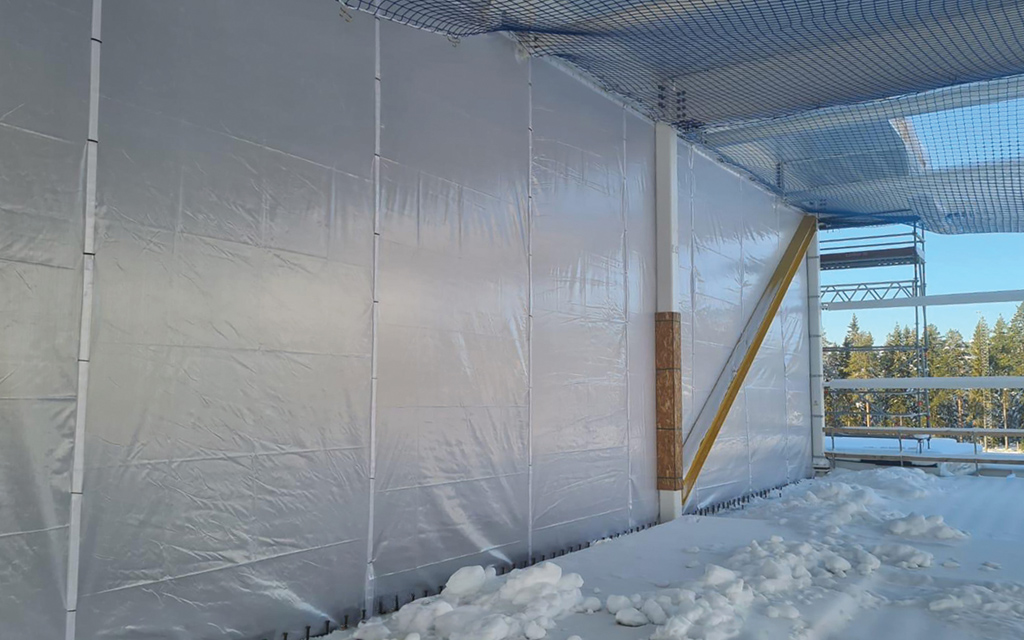
Cold slows concrete. Curing takes longer and concrete that freezes before it has gained enough strength can be damaged. Mortar and render have the same problem. On one Nordic data centre project, temporary weather protection was used to maintain workable conditions during temperatures of around -20°C.
Heat causes trouble at the other end because it changes workability and curing and rain stops pours, groundworks, painting, rendering and electrical fit-out. Standing water then slows plant, deliveries and people long after the rain has gone.
Why one lost day costs more than a day
A missed pour does not stay a missed pour. It pushes back steelwork, fit-out, commissioning and handover plus the trades behind it cannot start. This means that the programme loses the days the weather took and the momentum gained to this point.
The investment is impacted too. Missing the completion date can trigger liquidated and ascertained damages (LADs). Every extra week on site also carries preliminaries: plant, welfare, supervision and site management keep costing whether or not anyone is working. There is a knock-on impact to the client because a late handover delays the operation the building was built for.
Who pays for weather under JCT and NEC
Under the JCT Standard Building Contract, exceptionally adverse weather is a Relevant Event. It can earn the contractor an extension of time but not usually money, so the contractor absorbs the cost of the longer programme.
Under the NEC, weather is a compensation event when it is worse than the threshold set in the contract data, measured at the agreed weather station and set against a return period of once in ten years. That earns time and cost.
Most weather does not reach either threshold. Ordinary bad weather is the contractor's risk on both forms and an extension of time does not recover what the delay costs. Check the wording of your own contract before relying on this summary.
Where mission-critical programmes have no slack
These projects work back from a date that will not move. A data centre has a live-service date and commissioning and M&E installation wait for a protected building. Temporary screening can change that sequence. On one UK data centre project, weatherproof screening allowed internal fit-out to start earlier and helped reduce the programme by six weeks.
A semiconductor facility cannot start tool installation until the building is weathertight and clean. Similarly, a biopharmaceutical facility needs a controlled, contamination-free space before validation can begin. An automotive expansion has to fit inside a production shutdown and the shutdown does not wait for the cladding.
In each case the open envelope is the constraint and every activity that depends on it inherits the delay.
What temporary screening does to the sequence
Without temporary weather protection, internal work waits until the permanent envelope is sufficiently complete. Screening reverses that order.
Westgate Global’s engineered weather protection screen, Flexiscreen® hangs from the building's existing steelwork so it needs no scaffold or extra framework. Its v-overlap panel connection method gives an over 99% air and dust-tight seal, at any height and length, subject to survey.
With the open façades sealed, fit-out and services can start inside while cladding carries on across the other elevations. The same seal keeps dust out of areas that need to stay clean for tool installation or validation. For projects where dust contamination is as significant a programme risk as weather, temporary screening can also form part of the site's contamination-control strategy.
On an exposed elevation, Westgate Global calculates the wind load for that site and designs the screen to it.
What to settle before the programme is fixed
Screening earns the most when it is planned with the programme and the least when it is bought after the first lost fortnight. Four decisions shape the design.
- Start with the site. Coastal, elevated and open sites take more weather and the elevations facing the prevailing wind take the most.
- Then list the activities on or near the critical path that a wet or windy day stops.
- Next, decide what the screen has to withstand: exposed elevations need a project-specific structural and wind-load design.
- Last, decide how protection moves. A reusable, relocatable system can be moved between zones as the work progresses.
Westgate Global surveys, designs, engineers and installs the screening and signs it off. Send the drawings, the programme and your access dates and our expert team can tell you what your best solution is.
FAQs
At what wind speed does construction stop?
There is no single speed. The crane manufacturer's limits and the lift plan set when lifting stops and cladding and work at height have limits of their own. Check them for each activity on your site.
Can you pour concrete in cold weather?
Yes, with controls. The risk is concrete freezing before it has gained enough strength, so the specification and the conditions decide what protection the pour needs. An enclosure keeps wind and rain off the pour area and the specification decides whether heating or insulation is also needed to maintain internal temperature.
Does construction have to stop in winter?
No. Pours, rendering, painting and cladding need dry, calm windows but internal work does not once the envelope is sealed.
Is temporary weather screening only for large projects?
No. Westgate Global's data centre screening has been used on live projects for AWS, Intel, Meta and Vantage Data Centres because those programmes have the least slack. The same screening suits any project with weather-exposed work on the critical path.
Related Posts
Insights 24 September 2026