


Movable vs demountable vs relocatable partitions: the differences explained
The terms movable, demountable and relocatable are often used as if they mean the same thing. They do not, and choosing the wrong system for a factory or warehouse can leave you with walls that cannot keep up with how your site operates. This guide explains what each type of partition is, how they differ in industrial settings and how to decide which one suits your space. If you already know you need to divide a production area or warehouse, explore our range of industrial partitioning systems built for large, live environments.
Why the terminology matters
Most content on this subject is written for offices, where a partition might separate two meeting rooms. Industrial sites have different demands. Walls may need to run up to roof height, hold back dust, keep a chilled zone at temperature or contain noise from heavy machinery. Layouts also change as racking moves, production lines are added, and contracts come and go.
Understanding the difference between each type helps you specify a system that performs today and still has value when your operation changes. It also affects cost, installation downtime, and what happens to the materials when the wall is no longer needed in its current position.
What are movable partitions?
A movable partition is designed to open, close or change position quickly, often several times a week or even daily. In offices and hospitality venues, this usually means sliding, folding or stacking panels on a track. These retractable room partitions let one large space become two or three smaller ones in minutes.
In an industrial setting, the same principle often takes the form of retractable curtains or fabric walls on overhead tracks. They are a practical way to separate a loading bay from a picking area or close off part of a building that isn't being heated. Our Flexicurtain retractable curtain system works in this way, giving you a divider that can be pulled across when it is needed and drawn back when it is not.
Where movable systems fit best
- Spaces that change use daily or weekly
- Large openings that need full clearance for vehicles or goods
- Temporary segregation during seasonal peaks
- Areas where light or airflow needs to be restored quickly
What are demountable partitions?
Demountable partitions are non-load-bearing walls that can be removed without significant damage to the surrounding building. Unlike blockwork or plastered stud walls, they don't need to be demolished. Panels are fixed with mechanical connections so they can be unscrewed, unclipped or lifted out when the space needs to change.
The key point is that demountable does not always mean reusable. Some demountable wall partitions can be removed cleanly from the building, but parts of the wall itself may be damaged in the process and need replacing before the system can go up again. This is why some suppliers describe them as removable partitions rather than truly relocatable ones.
Internal demountable partitioning in industrial buildings
Internal demountable partitioning is common in warehouses and factories that are leased rather than owned. Landlords often prefer tenants to use walls that can be removed at the end of a lease, as it makes restoring the unit to its original condition quicker and cheaper. Typical uses include creating a site office on the warehouse floor, separating a goods-in area or enclosing a quality control room.
Many demountable partitioning systems are steel, fabric, or panel-based. Steel options suit secure storage and machinery guarding, while fabric and panel systems are often used where hygiene, dust or temperature control is the priority.
What are relocatable partitions?
Relocatable partitions take the demountable concept a step further. They are manufactured to be taken down and rebuilt elsewhere with little or no damage to their components. A widely used industry benchmark is that a relocatable system should allow the large majority of its original parts to be reused when it is reinstalled, often quoted as more than 80%.
For industrial sites, this is where the real long-term value sits. A relocatable wall can follow your operation as it changes, whether that means moving a production line, expanding a cold store or reorganising racking. One of our customers relocated a Flexiwall industrial partition after more than 20 years of service, showing how long a well-designed system can stay in use.
Movable vs demountable vs relocatable: key differences
Each type solves a slightly different problem. Here is how they compare on the points that matter most in an industrial building.
How often the layout changes
Movable systems are built to change daily or weekly. Demountable walls are usually taken down only occasionally, for example at the end of a lease. Relocatable systems sit in between and can be moved whenever your layout needs to change.
Impact on the building
All three avoid the demolition that comes with blockwork or plastered walls. Movable systems do not disrupt at all once installed, while demountable and relocatable walls leave only minimal marks when they are removed.
Reuse of components
Movable partitions stay in place and are reused every time they open and close. Some parts of a demountable wall may need replacing before it can be reinstalled. Relocatable systems are designed so most components can be reused.
Typical industrial uses
Movable systems suit retractable curtains and bay dividers. Demountable walls are common for site offices and lease fit-outs. Relocatable partitions are the natural choice for process segregation and long-term zoning that may need to shift over time.
Benefits of flexible partitions in factories and warehouses
Whichever category suits your site, flexible partitions offer clear advantages over permanent construction.
Faster installation with less disruption
Prefabricated systems avoid wet trades such as plastering, so installation is quicker and cleaner. Work can usually be planned around live operations, keeping production running while the new walls go in.
Dust, contamination and temperature control
The right partition can do far more than divide space. Systems can be sealed to limit dust and contamination, separate clean and dirty processes or create zones for temperature control. Flexiwall offers a 99% dust-tight seal and can be certified to ISO 7 cleanroom standard.
Noise reduction
Separating loud machinery from offices, packing areas, or welfare spaces improves working conditions. Steel and panel systems with acoustic performance can provide meaningful noise reduction in busy production environments.
Lower lifetime cost and less waste
Because the materials are reused rather than sent to landfill, relocatable systems reduce waste and avoid the cost of building new walls each time the layout changes.
Fire rated options
Where walls need to protect escape routes or high-risk areas, fire-rated panels are available across a number of systems, so compliance doesn't mean giving up flexibility.
Where modular hoarding fits in
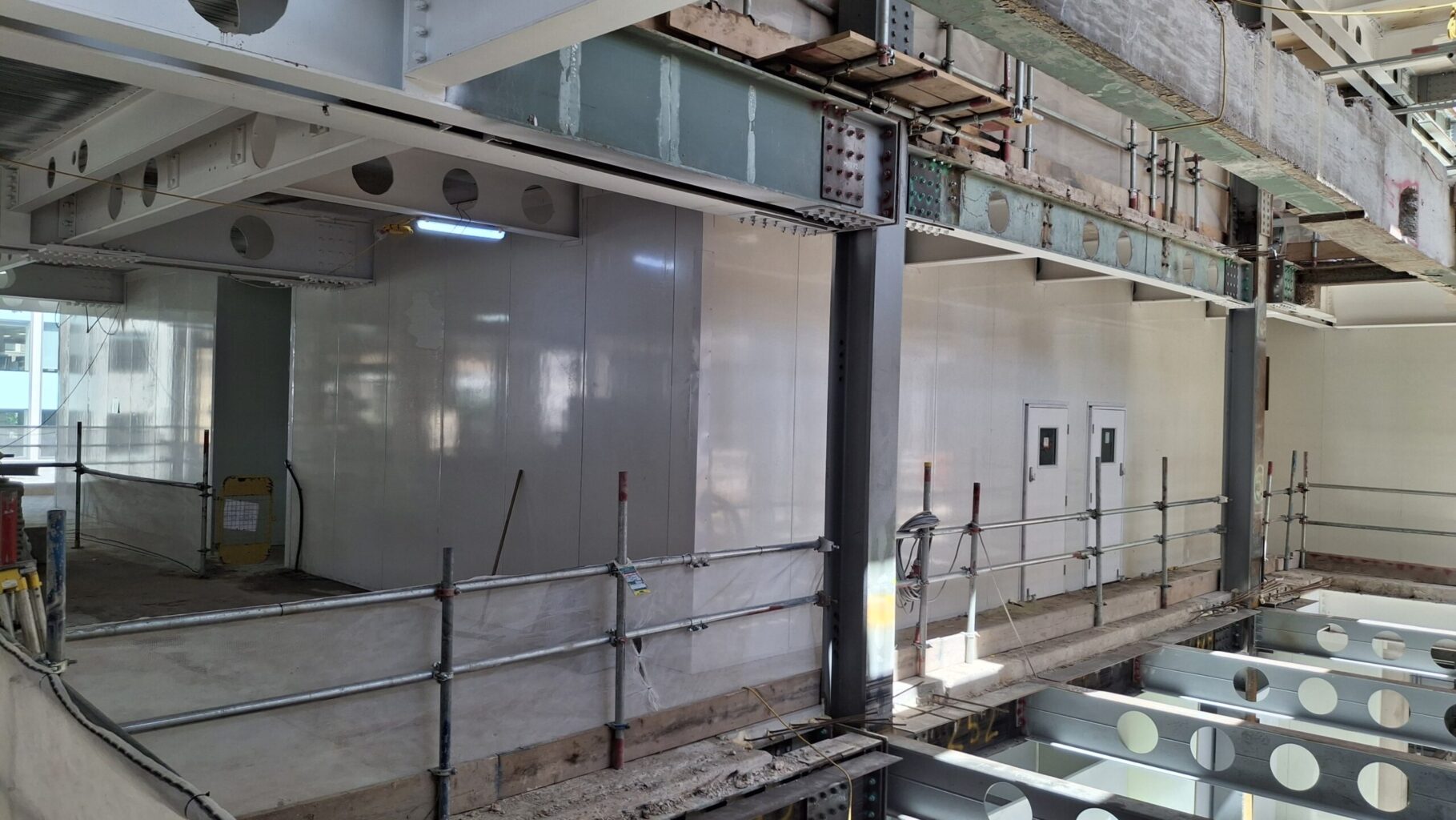
Modular hoarding panel systems sit between temporary and relocatable partitions. Our Hoardfast panel system can be freestanding or run floor to ceiling up to 5m high, and panels can be moved without leaving lasting damage. It is often used for site offices, welfare rooms, clean rooms and segregated production areas, as well as for screening during construction and refurbishment work.
How to choose the right partition for your site
Start by asking how often the space is likely to change. If it changes daily or weekly, a movable or retractable system makes sense. If the wall will stay in place until the end of a lease, a demountable system may be enough. If your operation evolves regularly and you want to protect your investment, choose a relocatable system.
Then consider what the wall needs to achieve:
- Height and span, especially in tall warehouses
- Dust, hygiene or cleanroom requirements
- Temperature or humidity control
- Acoustic performance around machinery
- Security and restricted access
- Fire rating for escape routes or high-risk zones
- Access for forklifts, pedestrians and goods
For secure storage or machinery segregation, a part-height steel system such as Anchorwall offers robust protection with the flexibility of a modular design. For full-height process segregation, a fabric-based system is often more cost-effective. Our guide to industrial fabric partition wall costs explains what affects pricing.
Partitioning solutions from Westgate Global
Westgate Global has more than 45 years of experience designing and installing partitions for manufacturing, warehousing and logistics sites. Our systems are designed around your space, installed with minimal disruption to live operations and built to be reconfigured as your business changes. To discuss your project, contact our team for expert advice.
Frequently asked questions
What is the difference between demountable and relocatable partitions?
Demountable partitions can be removed without damaging the building, but some of their components may be damaged in the process. Relocatable partitions are designed to be taken down and rebuilt elsewhere with most of their original parts reused.
Are movable partitions the same as demountable partitions?
Movable partitions are designed to open, close or slide regularly as part of daily use. Demountable partitions stay in a fixed position until they are taken down, which usually happens only when the layout changes or a lease ends.
Can demountable partitions be used in warehouses?
Yes, demountable partitions can be used in warehouses. They are widely used in warehouses and factories to create site offices, secure storage areas and segregated process zones, particularly in leased buildings where walls need to be removed at the end of the tenancy.
How tall can industrial partitions be?
How tall and industrial partition is depends on the system. Some panel systems reach around 5m, while fabric-based systems such as Flexiwall can be designed to any height and length to suit large buildings.
Are relocatable partitions more sustainable?
Generally, yes relocatable partitions are a more sustainable option. Because most of the components can be reused, relocatable systems reduce construction waste and avoid the need for new materials each time a layout changes.
Related Posts
Insights 28 October 2026
Modular hoarding: keeping construction sites productive in winter
Insights 28 October 2026